NEXP CON · REV C · 24 V DC · TAP A NUMBER
Everything from idea to manufacturer
One team for the hardware, the firmware and the app it reports to.
Schematic & PCB layout
Component choice, schematic capture and multi-layer layout, with the 3D model reviewed before anything is ordered.
Power & protection
Industrial supplies, fusing, surge and reverse-polarity protection, and isolated switching for loads that matter.
Compute & connectivity
Compute modules, LTE, GNSS and local buses (I²C, analog, servo) chosen for the job and its environment.
Firmware
Firmware that reads, switches and reports to your nexp instance — and keeps working safely when the link drops.
Prototypes & testing
Assembled prototypes, bring-up and a test plan you can repeat on every board that comes off the line.
Production handoff
Fabrication and assembly files, a costed bill of materials and the documentation your manufacturer needs.
Case study · NEXP CON v1.0.0
A greenhouse zone controller
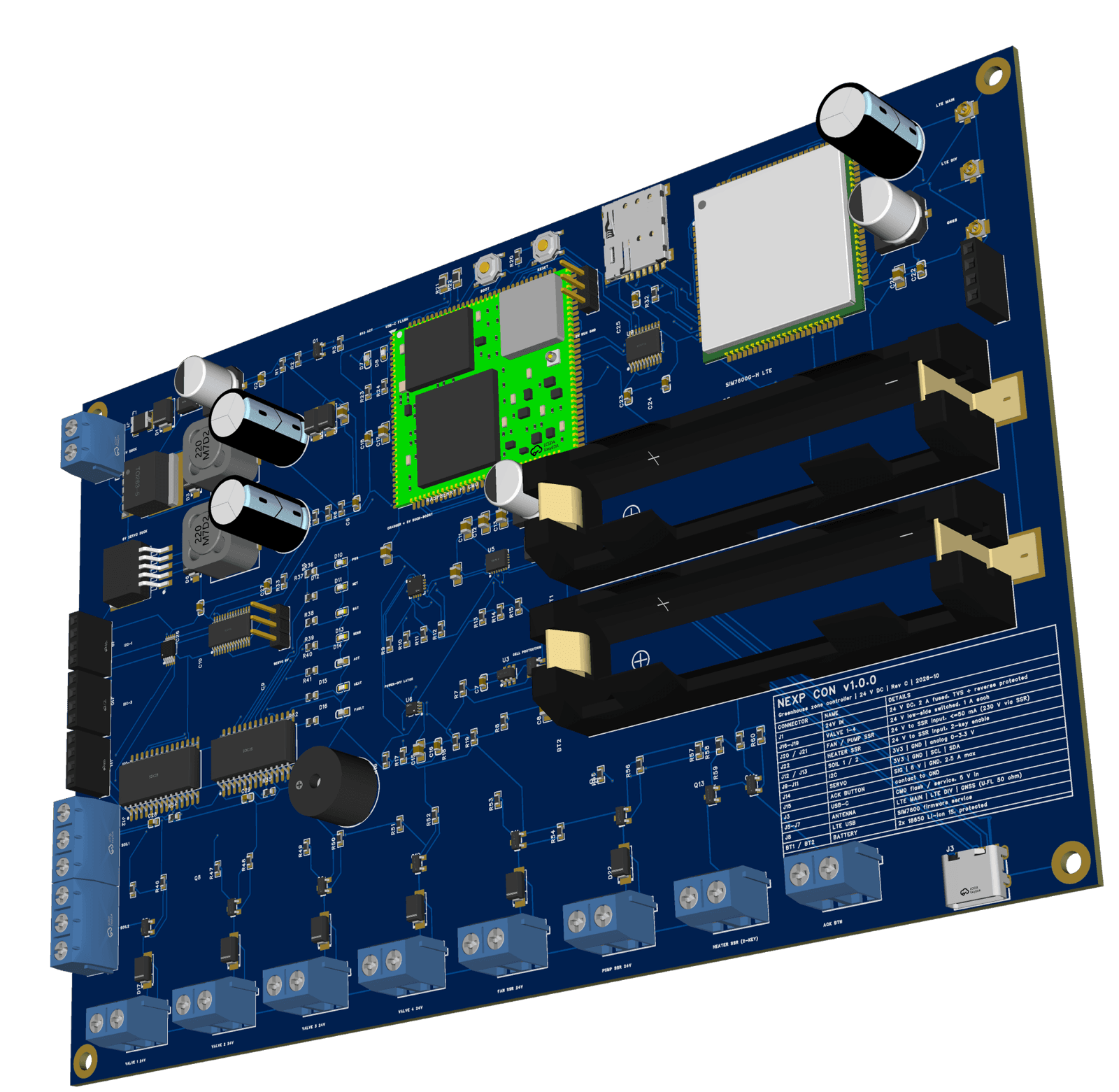
Designed for the nexp Greenhouse app: it reads the zone's sensors, drives valves, fans, pumps and the heater, and reports over LTE — with battery backup for power cuts. Pick a number to explore it, or read the greenhouse story.
NEXP CON · REV C · 24 V DC · TAP A NUMBER
Specifications
Rev C · 2026-10- Supply
- 24 V DC, 2 A fused, surge (TVS) and reverse-polarity protected
- Compute
- Raspberry Pi CM0, flashed over USB-C
- Connectivity
- SIM7600G-H LTE with GNSS; LTE main, diversity and GNSS antennas (U.FL, 50 Ω)
- Outputs
- 4 × 24 V valve outputs, low-side switched, 1 A each
- Relay drives
- Fan and pump relay inputs; heater relay with two-key enable
- Inputs
- 2 × analog soil (0–3.3 V), 2 × I²C, acknowledge button
- Servo
- 6 V servo port, 2.5 A max
- Backup
- 2 × 18650 Li-ion (1S), protected, with charger and power-off latch
- Indicators
- Power, network, battery, sensors, activity, heater and fault LEDs; buzzer
How we design
The habits behind every board, all visible on NEXP CON.
Protected at the edge
Every input from the outside world is fused and clamped; a wiring mistake costs a fuse, not a board.
Two keys for what can hurt
A heater only switches when two separate enables agree, so a single fault can't turn it on.
Keeps going without mains
Battery backup with cell protection lets the board report a power cut and shut down cleanly.
Made to be serviced
Labelled connectors, a connector map printed on the board, status lights and USB-C service access.
From first call to first production run
Five steps, each ending with something you can review.
- STEP 01
Discover
What it must measure, switch and report; where it lives; how many you need.
You get: Requirements and an approach
- STEP 02
Design
Schematic, component choice, PCB layout and a 3D review with you.
You get: Schematics, layout, 3D model
- STEP 03
Prototype
Boards assembled, brought up and tested against the requirements.
You get: Working prototypes, test plan
- STEP 04
Connect
Firmware reports to your nexp instance; screens and rules in your apps.
You get: Firmware, app setup
- STEP 05
Produce
Files and documentation for your manufacturer, and support for the first run.
You get: Fabrication & assembly files, BOM
Questions
Do I have to use nexp to work with you?
The boards can report to any system, but they are designed to plug straight into nexp, where readings, history, control and alerts are ready to use.
Can you start from an existing design?
Yes — we can review, extend or re-spin a board you already have, or replace an off-the-shelf module with something made for the job.
Who owns the design?
That's agreed at the start of each project and written into the proposal.
How many boards can you take to production?
From a handful of prototypes to a production run with your manufacturer; tell us the quantities you have in mind.